

How to write useful game development articles with AI
Use AI to help organize research and draft explanations, while a person verifies sources, tests examples and owns the final claims. Publish articles that solve distinct reader problems rather than producing near-identical pages for search terms.
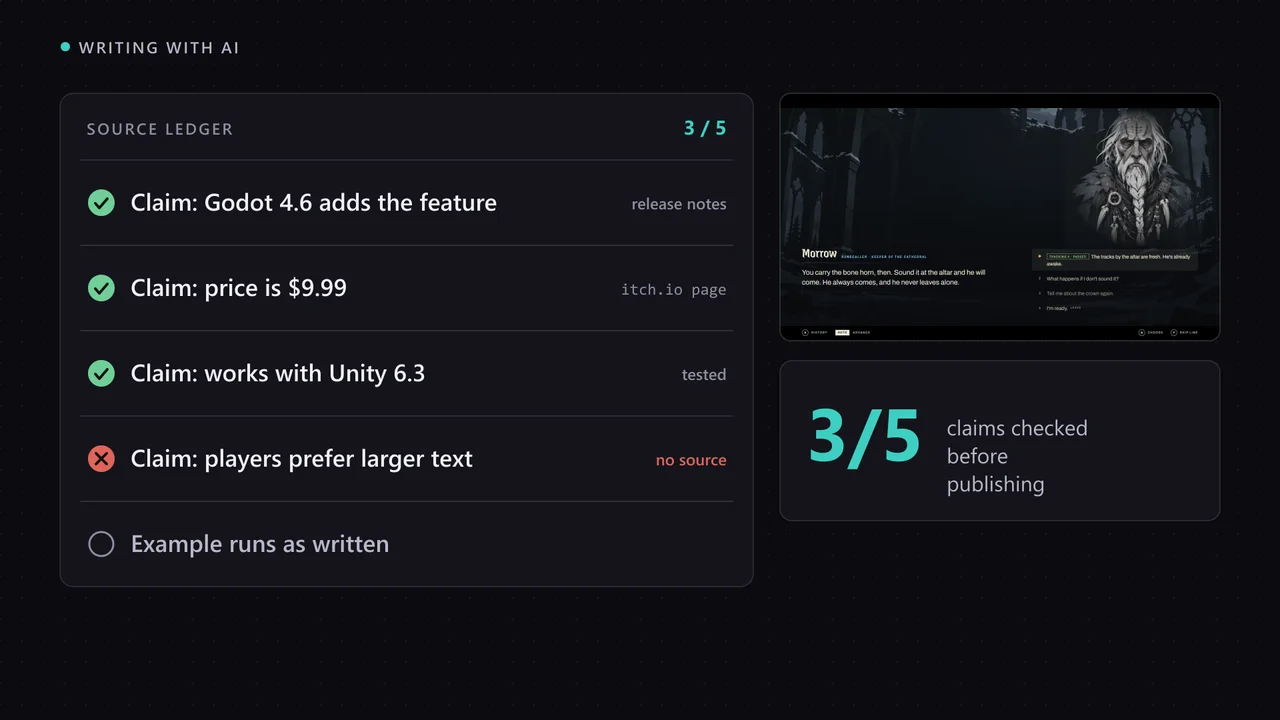
AI can turn a rough game development note into a plausible tutorial quickly. The difficult part is determining which details are true, current and useful to the reader. A made-up engine API or an invented performance improvement can waste hours for the developer who follows it.
Use the model as an assistant in an editorial process. A person still needs to choose the question, verify the evidence, review examples and take responsibility for what is published.
Start with a question you can answer well
A good brief identifies the reader, the decision they need to make and the evidence you can provide. For example:
| Brief element | Illustrative answer |
|---|---|
| Reader | A Godot developer adding keyboard and controller support to a menu |
| Question | How should focus move when a settings panel opens and closes? |
| Useful evidence | A tested focus sequence, screenshots and links to current engine documentation |
| Boundaries | The example covers the tested engine version and menu, not every controller configuration |
| Next action | Try the example and adapt the focus map to the actual screen |
Do not promise a tested result until the test has happened. If the article instead uses a fictional example, label it as such and explain which assumptions the reader must adapt. An article on AI search should also avoid implying that a game UI editor provides an SEO service or guarantees discovery.
Keep a source ledger
Before drafting, collect the sources needed for claims that can be checked. For an engine tutorial, these may include the relevant version of official documentation, the project’s actual files and a record of the test environment. For search guidance, use the search provider’s current documentation for its own product.
| Claim or instruction | Evidence to record | Editorial decision |
|---|---|---|
| A setting exists in a named engine version | Official documentation and, where possible, a checked project | Include the version and exact setting name |
| A workflow improved performance | Reproducible before-and-after measurements | Omit a numeric claim if measurements are unavailable |
| A game supports a platform | Current release or publisher information | Distinguish shipped support from a future plan |
| An example uses a specific API | A small test against the stated version | Correct or label the example if unverified |
Record source URLs and the date you checked them. A source may be accurate but irrelevant to a specific claim, so check the actual passage rather than citing the home page. Do not ask a model to invent sources or assume a citation it supplies exists.
Give the assistant bounded work
Provide the brief and source material, then ask for a concrete output. For example:
Audience: developers implementing controller navigation in a game menu.
Task: propose an outline and a checklist for focus behavior.
Evidence: use only the supplied engine documentation and our tested notes.
Constraints: distinguish tested behavior from assumptions. Flag missing facts.
Do not invent APIs, screenshots, test results, quotes or performance numbers.
The response is a draft, not an authority. Verify every command, link, API name, version and claim before release. Check examples in an appropriate project when they instruct readers to run code. If you cannot test something, narrow the claim or label the limitation.
Add the insight a template cannot provide
The strongest material often comes from the work around the obvious answer: a focus trap found during controller testing, a localization string that overflowed at a particular size, or a handoff contract that clarified event ownership. Explain the actual conditions and what changed. Preserve confidential project information and get permission before sharing someone else’s assets, conversations or data.
An AI-generated example can illustrate a concept, but it is not a customer case study. Use real screenshots only when you have the right to publish them and they represent the described state. Avoid invented quotes, authors, credentials and first-person experience. Explain limitations instead of filling gaps with confident language.
Edit for readers and search together
Write an accurate title and description, answer the main question early and use headings that reflect the decisions in the article. Link to relevant internal documentation and primary sources. Use a table or code example where it makes a decision easier, not as decoration. Remove repeated explanations and search terms that make the text less natural.
Google’s guidance on generative AI content allows AI as a useful tool while warning that producing many pages without adding value can violate spam policy. Its people-first content guidance is a useful editorial check. Neither a human-written label nor an AI-generated label guarantees a good result.
Before publishing, ask whether each article has a distinct job, whether its claims and links are checked, and whether a reader can complete the described task. Assign an owner or a review date for material likely to change. After publication, use AI search measurement to observe visibility and useful actions, keeping those metrics separate.
Questions people ask
Does Google prohibit AI-assisted articles?
Google does not prohibit using generative AI as a tool. Its guidance focuses on helpful, original content and warns against generating many pages without adding value for users.
Should an AI-written tutorial claim first-hand experience?
Only describe experience that actually happened. If an example is hypothetical or untested, say so; do not invent a developer, test result or customer story to make the article sound authoritative.
What makes a game development article useful?
It answers a specific reader question with accurate, relevant detail: a tested workflow, an honest example, the constraints that affect the result and links to the sources needed to go further.