

Game website crawlers: control search and AI access
Crawling, indexing and use for AI training are different decisions. Check the crawler documentation for each provider, keep the pages you want indexed accessible and use robots.txt and noindex for their intended purposes.
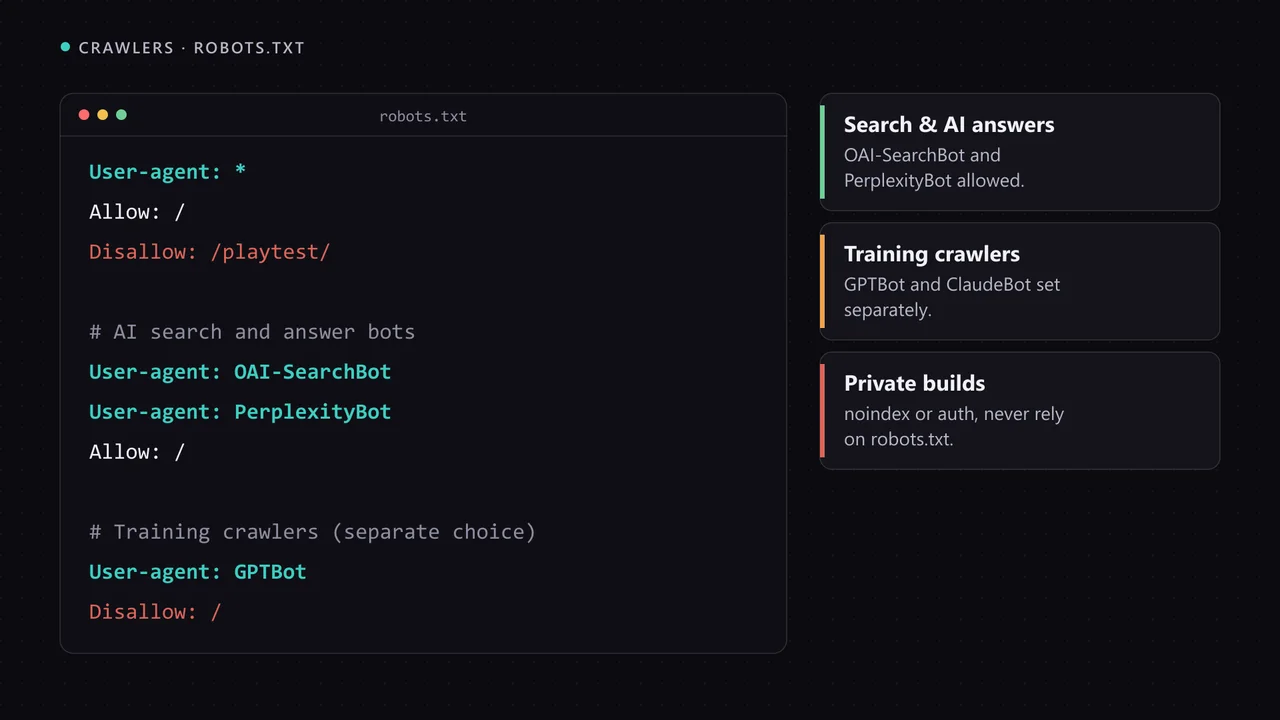
When a player searches for a game, the site’s crawler configuration can determine whether a search service can retrieve its public pages. It can also express separate preferences about some AI crawlers. Those are related decisions, but they are not the same setting.
Before changing anything, make an inventory: which pages should be public and searchable, which are public but should not appear in search, and which must remain private? A game overview and support guide may belong in the first group; a staging page may belong in the second; a private playtest build belongs behind authentication.
Separate crawling, indexing and privacy
Crawling is a bot fetching a URL. Indexing is a search engine storing and considering a page for search. A crawler can be allowed to fetch a page that you ask not to index, and a search engine can know a URL even if it is blocked from fetching its content.
robots.txt gives crawler instructions. It is public, normally located at the root of the relevant site’s origin, and is not an access-control mechanism. A noindex directive asks a search engine that honors it not to index a page. The bot must be able to fetch the page to see that directive; disallowing the same page in robots.txt can prevent this. See Google’s noindex documentation.
For a confidential press build, an unannounced feature or personal data, require authentication and limit access at the server. Neither hiding the link nor adding a robots rule makes a document private.
Decide which AI crawlers can access public pages
Crawler names and their uses are provider-specific. OpenAI documents OAI-SearchBot for search and GPTBot for content that may be used in training. It says these controls are independent. Its documentation also describes ChatGPT-User, which responds to user-directed requests and is not the same as a routine search or training crawler. Check the current OpenAI bot documentation before making a policy decision.
For example, these two groups express a choice to allow OpenAI’s search crawler and disallow its training crawler on public paths:
User-agent: OAI-SearchBot
Allow: /

User-agent: GPTBot
Disallow: /
This is an illustrative excerpt, not a complete robots file. Review existing rules before editing: a separate user-agent group can change which rules apply to that bot. Preserve needed disallows, test the resulting file and verify the live response at /robots.txt for each relevant host. These entries do not grant or block access for other companies’ crawlers, and they do not enforce a legal or technical boundary against noncompliant clients.
Check what a bot can actually receive
Open important URLs without being logged in. Confirm that the server returns the intended page rather than a login, error or accidental redirect. Inspect the response and the rendered page: can a visitor find the game’s description, supported platforms and relevant support text? Search engines differ in their ability and timing for executing JavaScript, so avoid making essential information depend on an interaction that a crawler cannot perform. Google’s JavaScript SEO guidance explains its rendering process and common problems.
For each important page, check:
- The page is linked from a relevant public page, and internal links point to its preferred URL.
- The URL does not unintentionally return an error, redirect loop or authentication screen.
- The relevant crawlers are allowed, and there is no unintended
noindexdirective in HTML or HTTP headers. - The canonical URL points to the preferred equivalent page. A canonical is a signal, not a guaranteed command.
- If you maintain an XML sitemap, it lists preferred, indexable URLs and stays current.
- Important descriptions are visible as text, with useful alternatives for meaningful images.
These checks improve the conditions for discovery; they do not promise indexing or inclusion in an AI answer. Use each provider’s inspection and reporting tools to investigate observed problems rather than assuming every bot behaves like Google.
Test a change without guessing
Record the existing file and intended outcome, make the smallest change and verify the deployed response. Test the specific crawler and path combinations that matter, including any staging or support sections. Check representative pages for both response headers and page-level directives. If you have access to a search engine’s inspection tool, request a fresh check and review its result; indexing changes need time and are not guaranteed.
When a crawler is blocked by a CDN or firewall, changing robots.txt alone may not solve the problem. Inspect server and security logs if available, and make a narrowly scoped change only after verifying the source of the failure. See the AI search guide for game developers for the content decisions that matter after a page is accessible.
Questions people ask
Does blocking a crawler remove a page from search?
Not necessarily. A blocked URL may still be known to a search engine. To request removal with noindex, the relevant crawler must be able to fetch the page and see the directive.
Can I allow ChatGPT search and block OpenAI training crawlers?
OpenAI documents OAI-SearchBot and GPTBot as separate controls. You can write different robots.txt rules for them, but those rules do not control every provider or substitute for access controls.
Is robots.txt a way to protect a private playtest?
No. Robots rules are public instructions to cooperative crawlers, not authentication. Keep private builds and documents behind access controls.