

Structured data for game websites: a practical guide
Structured data describes information already present on a page in a machine-readable form. Choose a type that fits the page, keep claims consistent with visible content and check the requirements of any search feature you want to use.
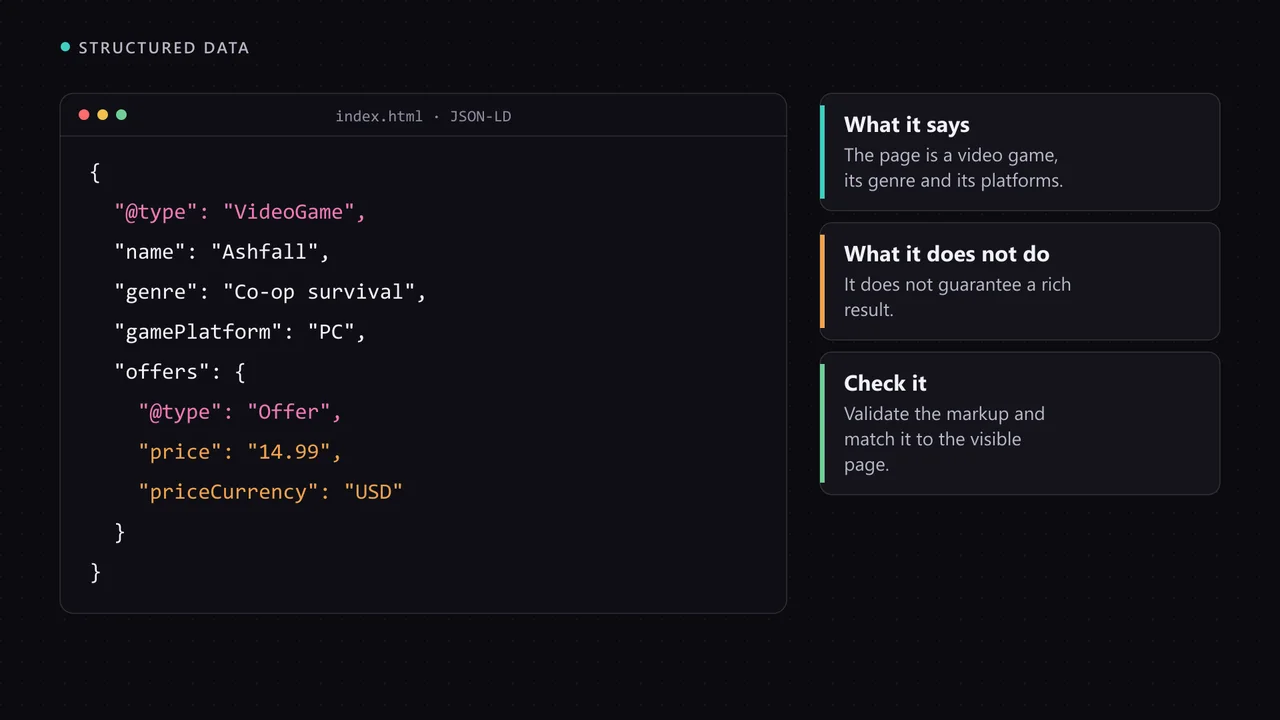
Structured data lets a page describe its subject using a shared vocabulary. For a game, that may mean identifying the title, genre and supported platforms. For a development article, it may mean describing the article and its publication date.
It is a translation layer for information that already exists on the page. It cannot make an unfinished game available on a platform, supply a review that never happened or guarantee placement in a search answer.
Match the markup to the page
Start with the primary purpose of the page, not a list of schema types to add everywhere:
| Page | Useful starting point | What to check |
|---|---|---|
| Game overview | VideoGame | The title, genre and platforms match the visible page |
| Development article | Article or a suitable subtype | Title, author and dates are accurate |
| Software listing | SoftwareApplication | Any offers, reviews and platform details are current and eligible |
The vocabulary and a search engine’s supported rich-result features are different things. A Schema.org type can be meaningful structured data even if a particular search engine has no special display for it. Conversely, satisfying a feature’s technical requirements does not mean that the search engine will show that feature.
A small example for a fictional game
Imagine a page for a fictional game called Lantern Vale. The visible page says it is a single-player adventure for Windows. The following JSON-LD describes those same example facts; replace every value with verified information about your own page before use.
<script type="application/ld+json">
{
  "@context": "https://schema.org",
  "@type": "VideoGame",
  "name": "Lantern Vale",
  "url": "https://example.com/lantern-vale/",
  "genre": "Adventure",
  "gamePlatform": "Windows",
  "playMode": "https://schema.org/SinglePlayer"
}
</script>
example.com and the game details are illustrative, not an existing product claim. Put real structured data in the page HTML, normally in the head or body. Keep it consistent with what a visitor can see, and update it when platform support or other facts change. Check whether your site framework already generates markup before adding another copy; duplicated or conflicting entities make maintenance harder.
This example is intentionally incomplete for Google’s software app rich result: it has no offer price or review. That is appropriate for an illustration, and it is better than inventing data.
Understand rich-result requirements
Google’s software app documentation currently lists an app name, an offer price and a qualifying rating or review among the required properties for that feature. Follow the linked review and general structured data guidelines as well. If your page has no eligible review, omit it and accept that the page is not eligible for that particular feature. Never manufacture a score or assume a third-party rating may be reused in markup without meeting the applicable requirements.
Keep visible prices, currencies and availability aligned with the actual offer. If a game is not yet available for sale, do not claim it is. Where pricing differs across stores or regions, avoid presenting a single stale price as universal. Recheck provider documentation when a feature matters to your launch.
FAQs help readers, with or without markup
A clear FAQ can answer questions about platforms, controls or accessibility. But Google announced that its FAQ rich result stopped appearing in May 2026 and later removed the feature documentation. See the Google Search documentation updates. Do not promise FAQ rich-result treatment from adding FAQPage data. Other services may interpret markup differently.
Similarly, Google does not require special AI-specific schema for AI Overviews or AI Mode. Its AI features guidance emphasizes the same underlying eligibility and page quality considerations as other search features.
Validate the real page and maintain it
- Inspect the rendered or fetched HTML for valid JSON-LD and the expected values.
- Use the Schema Markup Validator to inspect Schema.org vocabulary and relationships.
- For a supported Google feature, use the Rich Results Test and check the current feature documentation. A syntax pass is not a promise of a display.
- Compare the output against the visible page, including its offer, platform support, publication date and author where applicable.
- Recheck after releases, platform changes, redesigns and price changes.
If a page is blocked from crawling or marked noindex, fixing markup alone will not make it eligible. Start with the crawler and indexing guide, then use structured data to describe what is already there.
Questions people ask
Does VideoGame schema guarantee an AI search citation?
No. Structured data can describe a game, but neither valid markup nor a particular schema type guarantees a citation, ranking or rich result.
Should I add ratings to qualify for a rich result?
Only include genuine, eligible ratings or reviews that meet the relevant guidelines and are represented on the page. Do not invent ratings or copy unsupported numbers to fill a required field.
Does FAQPage schema create a Google FAQ rich result?
No. Google says its FAQ rich result stopped appearing in May 2026. A visible FAQ can still help readers, regardless of whether you add FAQPage markup.